 Fantom
 Lachesis and the Role of Event DAGs
· updatedLachesis is Fantom Opera's asynchronous Byzantine fault tolerant consensus protocol. Validators maintain local directed acyclic graphs (DAGs) of transaction events and use stake-weighted agreement to produce a single finalized transaction order without a central leader.
Event blocks and causal history
Validators batch incoming transactions into event blocks and connect events through references to earlier events. Each validator keeps its own DAG, with events as vertices and references as directed edges. These connections record dependencies between events and preserve information about the history their creators have observed.
Event creation and exchange can proceed concurrently across validators. Peers share their own events and events received from other nodes, incorporating valid history into their local graphs. Asynchronous communication allows this exchange to proceed without all validators creating blocks in lockstep. Agreement still depends on validators exchanging and validating information.
Agreement and the finalized chain
Lachesis uses graph layering, Lamport timestamps, and concurrent common knowledge to derive a consistent total order. Lamport timestamps are logical counters for ordering events; they do not require every validator's physical clock to show the same time.
Opera's finalized blockchain stores the ordered result. A block explorer presents this final chain, while event creation and DAG exchange occur inside the validator network. The DAG records concurrent event relationships, and the blockchain provides the agreed sequence of finalized transactions.
Epoch checkpoints divide the local history Lachesis processes to manage DAG storage and processing work. The finalized Opera blockchain remains the transaction record.
Stake weight and fault assumptions
Proof of stake supplies the validating power used in the weighted model described in Lachesis: Scalable Asynchronous BFT on DAG Streams (version 1, submitted August 4, 2021). Each node's first event is an initial root. Later root selection uses a quorum above two-thirds of total validating power, together with the protocol's forkless-cause rule for excluding observed forks. In this model, a root can be selected as a Clotho, an Atropos candidate. Once an Atropos is decided, events in its history that earlier blocks have not included are ordered into a new block.
The paper's fork-free argument assumes malicious participants control less than one-third of total validating power. These thresholds concern stake weight, so validator headcount alone does not establish the required quorum or fault tolerance.
Deterministic and probabilistic finality
Opera documentation describes approximately 1-2 seconds for transaction finality. This describes the consensus process and does not establish an unconditional completion deadline for every submitted transaction. A transfer's inclusion in a finalized Opera block establishes consensus finality; a submission receipt confirms only submission. If the reported status shows a validation failure such as insufficient balance, correct that cause before resubmitting.
| Consensus approach | Finality model | Role of later blocks |
|---|---|---|
| Lachesis on Opera | Deterministic, within the protocol's fault assumptions. | Once finalized, a transaction does not need additional blocks to make its consensus decision progressively more certain. |
| Nakamoto-style consensus | Probabilistic. | Additional blocks increase confidence by making reversal of earlier transactions less likely. |
Consensus and contract execution
Lachesis establishes agreement on transaction order, while the Ethereum Virtual Machine executes Opera's smart contracts. Opera supports EVM contracts written in Solidity and Vyper. Compatibility concerns contract execution; Opera retains its own consensus protocol and ledger.
Opera after the Sonic launch
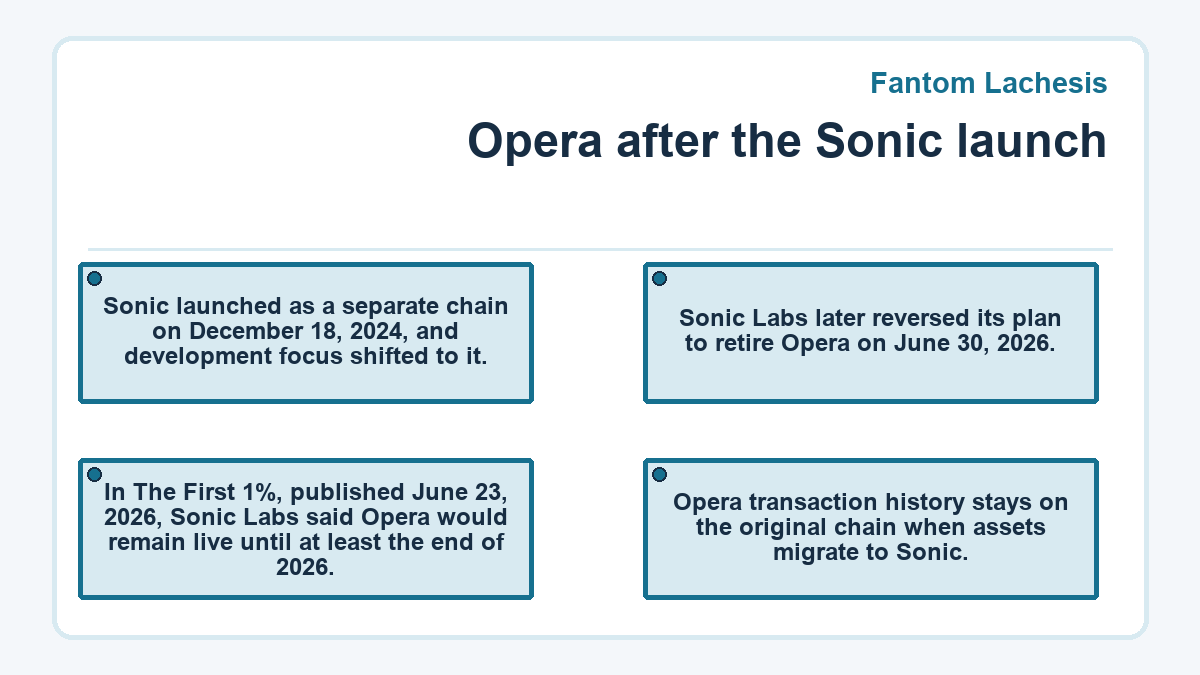
Sonic launched as a separate chain on December 18, 2024, and development focus shifted to it. Sonic Labs later reversed its plan to retire Opera on June 30, 2026. In The First 1%, published June 23, 2026, Sonic Labs said Opera would remain live until at least the end of 2026. Opera transaction history stays on the original chain when assets migrate to Sonic.